What building coverage and impervious area mean
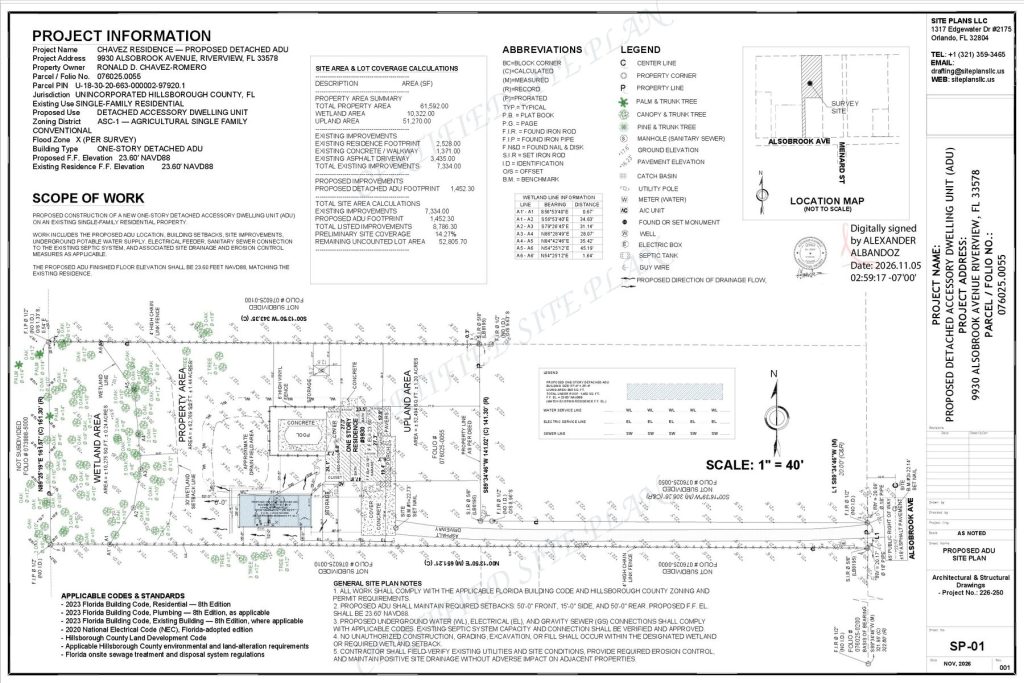
Building coverage is the share of a lot covered by buildings. Many local codes count the footprint of the house, garage, sheds and other roofed structures, and some also count roof projections or covered patios. The list depends on the zoning code that applies to your property.
Impervious area is the share of a lot covered by surfaces that do not absorb rainfall easily, such as roofs, driveways, walkways and parking areas. Local definitions differ. Raleigh's stormwater guidance lists pavers, gravel patios, artificial turf and typical slatted decks among its examples, and Austin's pool and deck guide ties allowable impervious coverage to a property's zoning.
The two totals are useful because they answer different questions. One is about how much of the lot is built on. The other is about how much of the lot is covered by hard surfaces that shed rainwater. The EPA describes rooftops and paved surfaces as examples of cover associated with stormwater runoff. This worksheet only adds up areas. It does not design drainage or storage.
When one surface counts in both totals
A house footprint usually counts toward both building coverage and impervious area. A driveway or walkway usually counts only toward impervious area. Each total is its own calculation, so you set the treatment for each surface twice: once for building coverage and once for impervious area. The worksheet lets you count a surface at 100%, leave it out, or enter a partial rate with a note about where the rate came from.
Count each area once
Within a single total, the same horizontal area should be counted only once. Two common overlaps are paving under a roof and a new addition built over an existing patio. For a full or partial replacement, record the existing area, remove the part being replaced, then add the new surface with its new treatment. The tool cannot detect overlap from the numbers you enter, so check your rows before you rely on the totals.
Use your agency's worksheet to confirm treatment
Many permit offices publish their own coverage forms. The Greenacres, Florida lot coverage form separates existing and new area, and Westmoreland County's worksheet for additions accounts for removed cover as well as added cover. Use this tool to organize your numbers and see every step, then confirm how each surface is treated with the office that will review your project.
How the math works
Final area = existing area − removed area + added area. Percent of lot = 100 × area ÷ lot area.
The worksheet runs this calculation separately for building coverage and impervious area. Areas are stored in square feet (one acre is 43,560 ft² and one square meter is about 10.7639 ft²) and rounded only for display.
Worked example: an 8,000 ft² lot
An illustrative lot has a 1,600 ft² house (counts in both totals), a 600 ft² driveway and a 200 ft² patio (impervious only). The owner removes 120 ft² of the patio, adds a 400 ft² building footprint (both totals) and adds a 150 ft² path (impervious only). The new building covers the area where the patio portion was removed, and all other listed areas are separate.
| Total | Existing | Removed | Added | Final | Change |
|---|
| Building coverage | 1,600 ft²
20.000% | 0 | 400 | 2,000 ft²
25.000% | +400 ft²
+5.000 pp |
| Impervious area | 2,400 ft²
30.000% | 120 | 550 | 2,830 ft²
35.375% | +430 ft²
+5.375 pp |
If this example had a 40% impervious limit, the maximum counted area would be 3,200 ft², and the final 2,830 ft² would be 370 ft² below the limit entered. That 40% figure is only an illustration. Enter a limit only when you have confirmed one from your reviewing office.
Frequently asked questions
Do roof overhangs count?
It depends on the local definition. Some codes count only the footprint at the walls, while others count roof projections beyond a set distance. Enter an overhang as its own row so you can include or leave it out once you have confirmed the rule.
Do pavers count as impervious area?
Not automatically either way. Some agencies list pavers and gravel among impervious surfaces, and others allow a partial rate for certain installations. Choose Unknown, or a partial rate with a source note, until you have confirmed the local treatment.
How do I enter a pool?
Treatment varies. The pool and the deck around it may be counted differently, so enter them as separate rows and confirm each one with the reviewing office.
How do I enter a replaced driveway or patio?
Record the existing surface, use Remove all or part for the portion coming out, then add the new surface. If you replace an area with the same size of surface and the same treatment, the net change in that total is zero.
Where do I find my effective lot area?
A recent survey or an approved plan is the best source. A county assessor's parcel size is often an estimate, and some jurisdictions measure limits against a net lot area after easements or dedications. Ask the reviewing office which lot-area basis its limit uses, and use the Advanced options if the two totals use different bases.